Les guides pour les nuls
- Combinatorics
- Conditional Probabilities
- Expectated Value, Variance, and Covariance
- Common Distributions
Combinatorics
Combinatorics is some flavor of choosing $k$ members from a set of $n$ and finding out how many possible subsets $z$ there are. These are incredibly practical to backpocket in the day to day.
Basic combinatorics can be split into 2 categories and each with 2 subcategories, making 4 cases in total.
- Permutations: order of selection MATTERS
- Combinations: order of selection DOES NOT MATTER
Permutations
With replacement: $z = n^k$
Without replacement: $z = \frac{n!}{(n-k)!} = n(n-1)(n-2)…(n-k+1)$
these are the more intuitive of the bunch, convince yourself
Combinations
Without replacement: $z = \binom{n}{k} \triangleq \frac{n!}{k!(n-k)!}$
notice this is just permutation w/o replacement normalized by k! which represents the number of ways to order k elements
With replacement: $z = \binom{n+k-1}{k} \triangleq \frac{(n+k-1)!}{(k)!(n-1)!}$
the intuition here is significantly more difficult to grasp without mentally restructuring the problem. hint: instead of thinking of ways to select k elements, think of ways to partition a set of m elements with k boundaries.
Additional notes on Combinatorics
- The formulas for combinatorics are not complex. What is more critical is recognizing which IRL scenarios boil down to what type of combinatorics problem.
- Example of Perm w/o replacement: all possible 1st, 2nd, and 3rd place podiums among n competitors
- Example of Perm w replacement: creating a 4 digit PIN for you phone
- Example of Comb w/o replacement: All possible 5-card poker hands.
- Example of Comb w replacement: All possible boxes of a dozen donuts you can buy from a store (assuming none run out).
- As an exercise in solidfying intuition, it is also useful to see how these combinatorics scenarios evolve as $n\rightarrow \infty, \bar{k}$ or when $k\rightarrow \infty, \bar{n}$
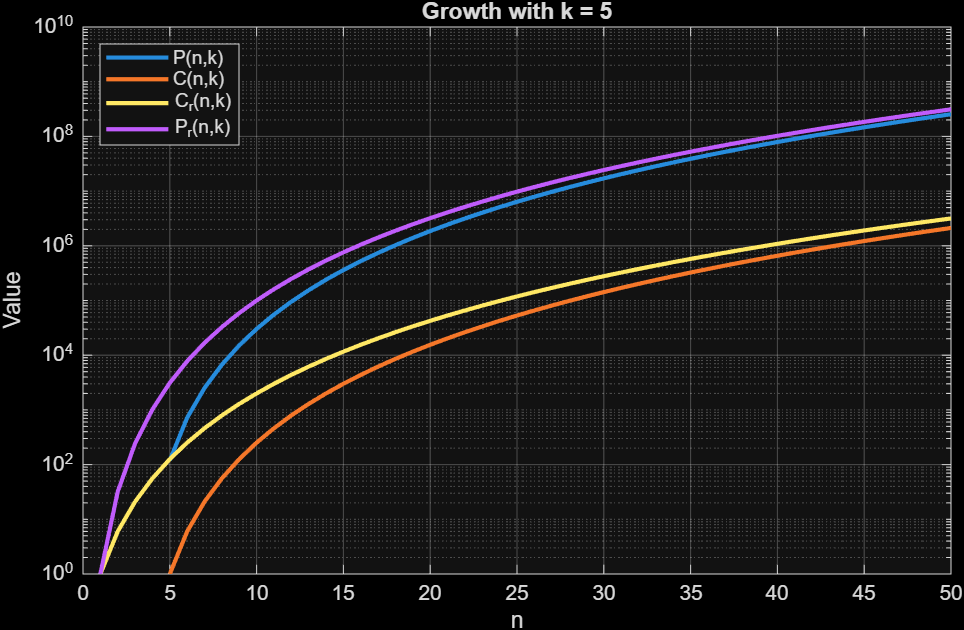
- relative order is invariant in $n$ where $n\neq 0$. ($P_r(n,k) > P(n,k) > C_r(n,k) > C(n,k)$).
- blue and orange curves start at $n=k$ because $n<k$ is absurd when not selecting with replacement.
- as $n\rightarrow \infty$, replacement and no replacement makes less and less of a difference. ($P \rightarrow P_r$ and $C \rightarrow C_r$)
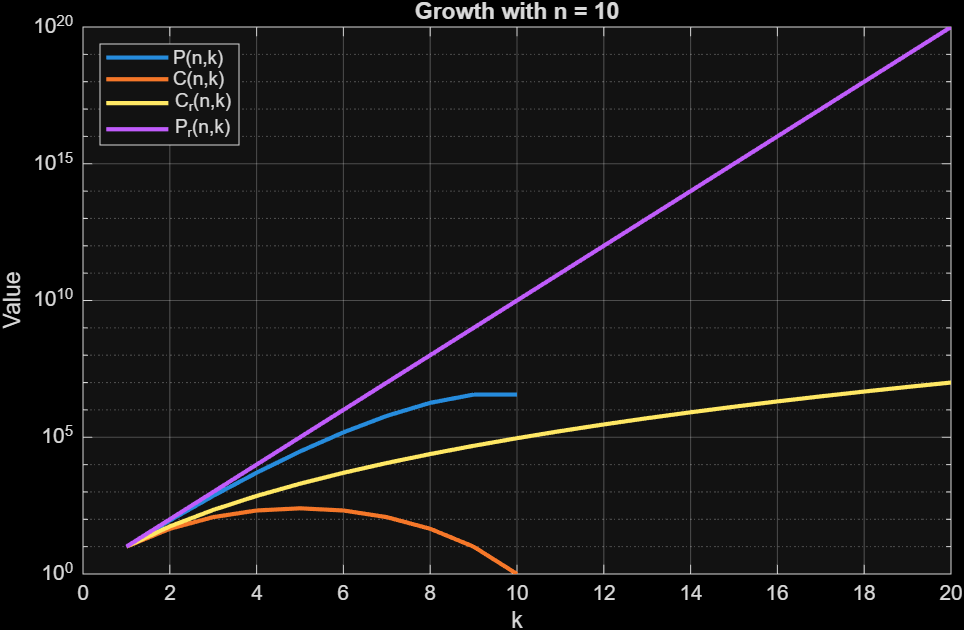
- relative order is invariant in $k$ where $k > 1$. ($P_r(n,k) > P(n,k) > C_r(n,k) > C(n,k)$).
- blue and orange curves end at $n=k$ for same absurd reason that $n<k$.
- $C(n,k) is the ONLY combinatoric that is NOT monotonically increasing.