Les guides pour les nuls
IndexComplex Numbers
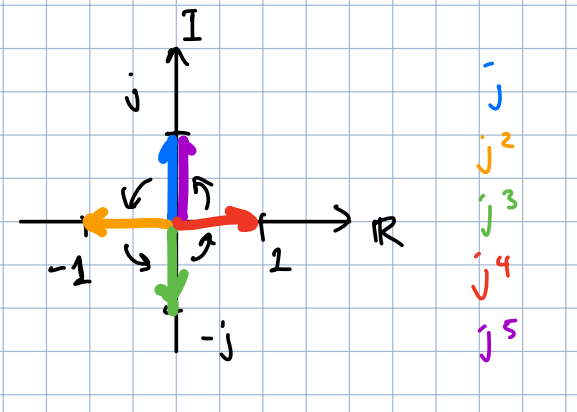
We learn in high school complex numbers are a simple mathematical definition where $j = \sqrt{-1}$. This seemingly innocuous number has a hidden rotational property to it.
\[j = j, \quad j^2 = -1, \quad j^3 = -j, \quad j^4 = 1, \quad j^5 = j\]Realize that when plotted on a complex plane, the act of multiplying a complex number by $j$ becomes a $90 \degree$ CC rotation. This is an insanely useful property that is leveraged heavily in electrical and controls engineering.
Euler’s Equation
Largely considered the most beautiful equation in math, the Euler Equation is as follows
\[\]Useful Identities
Transforms
Laplace Transform
The essence of a Laplace transform lies in how it captures both natural exponentials and frequencies of a system. The Laplace transform is the cornerstone of dynamical systems and control theory where transients are involved. It converts a function in the time domain to the complex domain and vice versa through its inverse.
This is the Laplace Transform $\mathcal{L} | f(t) \rightarrow F(s)$.
\[\mathcal{L}([f(t)]) = \int_0^\infty f(t) e^{-st} dt = F(s)\] \[\mathcal{L}^{-1}([F(s)]) = \frac{1}{2\pi}\int_{\sigma -j\omega}^{\sigma + j\omega} F(s) e^{st} ds\]